THREE QUESTIONS TO HEINRICH WANSING

1) When and how did you first hear about paraconsistent logic and start your work?

As far as I remember, I first heard about paraconsistent logic from my PhD thesis supervisor at the FU Berlin, David Pearce. This must have been in 1989. David got interested in Nelson's paraconsistent four-valued logic with strong negation and constructive implication and in logic programming. At that time I was certainly also aware of relevance logic (as I wrote a review of D. Gabbay und F. Guenthner (eds.), Handbook of Philosophical Logic, Vol. III: Alternatives to Classical Logic for the Zeitschrift für Sprachwissenschaft). I started my work on paraconsistent logic with the work for my PhD thesis that appeared as The Logic of Information Structures, Springer Lecture Notes in AI 681, Springer-Verlag, Berlin, 1993.


Born in 1963 in Ahaus, Germany.


2) How did you further develop your work on paraconsistent logic?
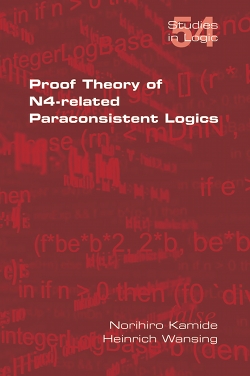
I further developed my work on paraconsistent logic in co-operation with a number of colleagues who I had the pleasure to host as Alexander von Humboldt Research Fellows, namely in the first place Sergei Odintov and Norihiro Kamide, or as a Friedrich Wilhelm Bessel Awardee of the Alexander von Humboldt Foundation, namely Yaroslav Shramko. With Sergei Odintsov I wrote two papers on inconsistency-tolerant description logic, and a number of other papers on paraconsistent modal logics. With Norihiro Kamide I wrote several papers and the book Proof Theory of N4-related Paraconsistent Logics, Studies in Logic. Vol. 54, College Publications, London, 2015. With Yaroslav Shramko I studied some 16-valued logics defined over a trilattice of generalized truth values. This project started from the basic paraconsistent relevance logic FDE as a logic of how a computer should deal with information. Most of our research was summarized in the book Truth and Falsehood. An Inquiry into Generalized Logical Values, Trends in Logic. Vol. 36, Springer-Verlag, Berlin, 2011.
In 2005 I wrote a paper on a paraconsistent connexive modal logic, and that was the starting point for me to work on systems of connexive logic that are not only paraconsistent but also nontrivial but inconsistent. Also, I got interested in bi-intuitionistic logic. The constructive co-implication of bi-intuitionistc logic, also called "Heyting-Brouwer logic," can be traced back to work by Skolem and Moisil. The co-negation of bi-intuitionistic logic is a paraconsistent negation, so modern paraconsistent logic can be seen as having started already before the seminal work of Jaskowski, Da Costa, Anderson and Belnap, Routley, Meyer, Priest and others.


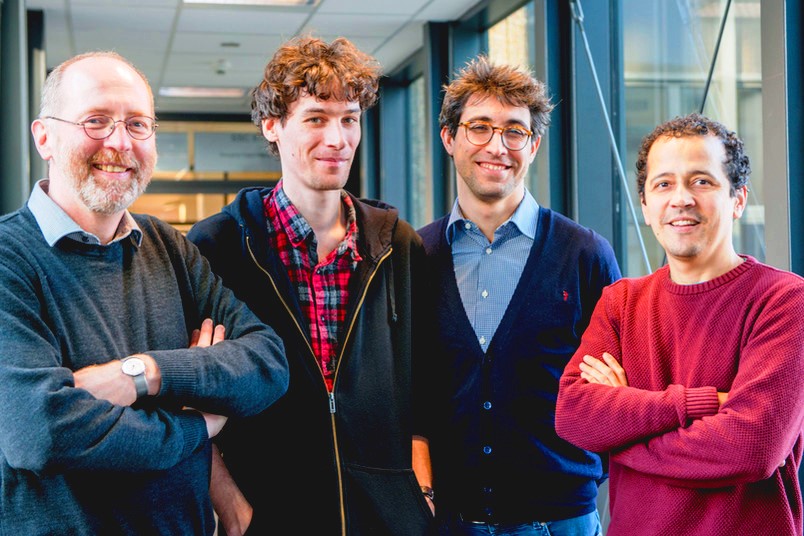
Wtih some of his collaborators in Bochum


In 2013 I hosted Graham Priest when he received a Humboldt Reasearch Award, and since December 2018 it is my pleasure to have Hitoshi Omori as a colleague who is leading a Sofja Kovalevskaja research group at Ruhr University Bochum devoted to a systematic study of paraconsistency and dialetheism.

3) How do you see the evolution of paraconsistent logic? What are the future challenges?
I think I have no particular opinion on the evolution of paraconsistent logic. I would say that it is a thriving field with many interesting things going on, especially in computer science logic. There are several challenges. One challenge for me is to better understand philosophically that there exist naturally arising nontrivial inconsistent logics. Another challenge is to take paraconsistency seriously to the extent of using a system of paraconsistent logic as a metatheory. This is a real challenge if in that system negation as falsity does not contrapose and the classically and intuitionistically valid negation introduction rule is not available for it.