|
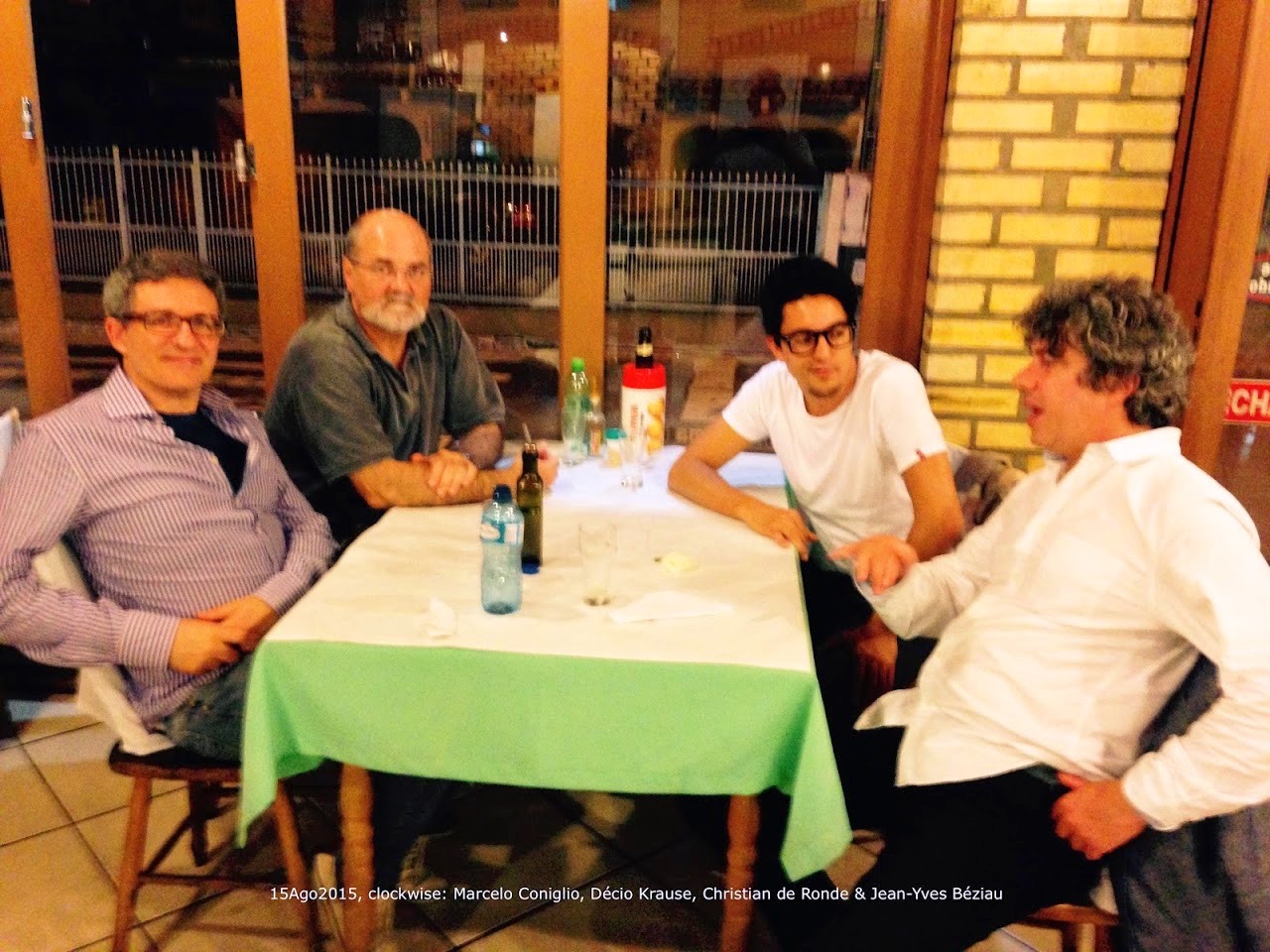
Décio with friends in Florianópolis in 2015
3) How do you see the evolution of paraconsistent logic? What are the future challenges?
Here is not the forum to make a history of PL, since by definition I am sure that the readers of these Letters know already about the subject and its history (and stories as well). Evandro Gomes and Itala D'Ottaviano's book (Para além das Colunas de Hércules, uma história da paraconsistência - De Heráclito a Newton da Costa) shows us the history with details and interpretations. The book, published in Portuguese, gained an English version which will appear soon.
But the evolution of PL is something impressive both in variety and in profundity of results. Computation is perhaps the field where relevant applications have being recently found (Towards Paraconsistent Engineering), but I still regard the role of PL in foundational issues as quite important, both in mathematics and in the sciences. In particular in the empirical sciences, we can look for the meaning and of course the existence of contradictions in scientific theories, but firstly we need to understand what a contradiction means in this field. An example may help. Take for instance quantum mechanics. It is usually said that Schrödinger's cat is both alive and dead (before measurement), that a particle can be in two places at once, that the particle passed trough both slits simultaneously (unfortunately I need to suppose certain knowledge of these experiments here), so that the use of some PL would be in need. I don't agree, at least in what concerns the mentioned cases; for instance, a particle has not position, but what we can call "state-positions".
To emphasize, the problem, as said before, is with the concept of negation, something I report quite important to make clear as one of the PL challenges. Firstly, it is agreed by quantum logicians that `quantum negation' is not `classical negation' (look at (Contradiction, Quantum Mechanics, and the Square of Opposition). The best explanation I know about these negations, came from Priest and Routley and was explored by Beziau
(“Round squares are no contradictions”) ; it is the reading of paraconsistent negation as subcontrariety in the Square of Opposition. Although these mentioned authors didn't mention quantum negation, we can consider that quantum negation is mapped by contrariety. In fact (in a very simple way), before measurement the cat is in a superposition of states "alive" and "dead", but these are not actual states of the cat, so it definitively is not both alive and dead. Both "to be dead" and "to be alive" are not states of the cat; they are both false, so to say, for the cat is in another state, described by a superposition. In the same vein, subcontraries can be both true in a sense, giving a more intuitive idea (although still vague) of what a paraconsistent negation means. It could be guessed that it would be interesting to define a dual of a superposition involving sub-contrary propositions and to explore this idea.
Recently, Kherian Gracher, a former student of mine, has analysed these negations in his PhD thesis at UFSC.
PL, and paraconsistency in general, is a huge subject with potentially infinitely many possibilities. Its link with fuzzyness is something relevant, and (in my readings) can be achieved by means of annotated logics. Perhaps the most interesting application would be to enable intelligent systems to deal with huge data bases where contradictions may be found due to both the quantity of stocked information and the differences of opinion, such as in medicine and law. These logics probably will of course not save someone from jail, but at least will avoid that the system collapses in the presence of a contradiction.
The pursue of the logical foundations of scientific theories, so going in the direction of Hilbert's 6th mathematical problem is something still in line, in particular in the axiomatization of theories where (apparently) some form of contradiction might occur, such as Bohr's theory for the atom (although this is also disputable). We cannot anticipate, but the future of these logics is to be great, so that maybe in the future some form of PL turns to be our `classical logic'.
|